Perecível
Transport food, flowers, and fruits quickly and efficiently, so that your products reach their destination in perfect condition.
What we offer
- Reduced transport time
- Careful handling at all stages of transport
- Segregation of incompatible loads at terminals
Product information
Perishable cargo
Perishable cargo is accepted according to IATA’s Perishable Cargo Manual, with different handling procedures based on the type of perishable items being transported, including wet cargo, horticultural products (fruits, vegetables, flowers, and plants), and animal products.
General Requirements for Perishable Cargo
- Wet Cargo (e.g., fish, shellfish, salted hides, meats): Wet cargo must be packed in leak-proof, robust containers that prevent any leaks, spills, or contamination, ensuring the protection of the aircraft, other cargo, and passenger baggage. Additionally, the packaging must prevent strong odors from escaping, ensuring no inconvenience to passengers.
- Horticultural Products (e.g., fruits, vegetables, flowers): Horticultural products must be packed in moisture-resistant containers capable of withstanding stacking up to 2.2 meters without the risk of box collapse. For plant-based products within the Brazilian domestic market, the Phytosanitary Certificate issued by MAPA (Division of Vegetable Products) must be included.
- Live Seafood (e.g., lobsters, shrimp, prawns): Seafood is only accepted in containers compliant with IATA’s Live Animal Regulations. These cannot be sealed containers. In the Brazilian domestic market, a Certificate of Origin from the MAPA Animal Products Division must be included.
Packaging Standards for Perishables
While the packaging requirements vary depending on the type of perishable product, the following general standards must be met:
- Protection Against Spoilage: Containers must protect the contents from spoilage and mitigate risks associated with transportation, such as temperature fluctuations or moisture exposure.
- Environmental Shielding: Containers must be designed to minimize the vulnerability of the product to changes in the environment (e.g., temperature, humidity).
- Strength and Stacking: Containers must be strong enough to withstand stacking of boxes weighing the same up to 3 meters high for at least 24 hours without any risk of the bottom container collapsing.
Wet Cargo Packaging:
For seafood and fish, containers must be leak-proof or made leak-proof by using polyethylene sheeting (0.1 mm thick). Expanded polystyrene boxes with wet ice are commonly used.
Seafood Packaging Example:
Seafood transported with wet ice must be packed in expanded polystyrene containers with sufficient thickness as follows:
- 10 kilograms: 20 mm minimum thickness
- 10 to 20 kilograms: 25 mm minimum thickness
If seafood releases large amounts of fluid, wrap it in polyethylene sheeting, and place an absorbent pad at the bottom of the container.
Meat Packaging Example:
Meat shipped with dry ice packed in waterproof, leak-proof containers or containers made waterproof through the use of polyethylene sheets.
Packaging Guidelines:
- Ensure containers are sturdy and capable of withstanding low temperatures without compromising their integrity.
- The use of polyethylene sheeting is recommended to enhance waterproof capabilities if the container is not inherently waterproof.
Labeling Requirements:
- Clearly label the outside of the box with the type of meat product contained, such as “Frozen Meat”, “Chilled Meat”, or “Fresh Meat”.
- Include a label indicating the presence of dry ice, such as “Contains Dry Ice”, to inform handlers of the necessary precautions.
- Ensure that all labeling complies with the sanitary regulations of the countries of export and import.
Additional Note:
All shipments must adhere to international sanitary regulations, ensuring that the packaging materials are approved for food transport and that the meat remains uncontaminated throughout the shipping process.
Note on Wet Products Packaging:
If using containers other than polyurethane or expanded polystyrene (e.g., particle board, corrugated cardboard), ensure they meet the same leak-proof and moisture-resistant requirements.
Special Conditions for Coolants
Dry Ice (Solid Carbon Dioxide):
Dry ice, classified as hazardous material, is subject to IATA’s Hazardous Materials Regulations. Special care must be taken to comply with restrictions on dry ice amounts due to aircraft ventilation limits.
- Dry ice must not be placed next to live animals or fertilized eggs.
- Dry ice is not suitable for fresh fruit or vegetables unless used in a ULD specifically designed to control gas flow.
- Ensure that containers used for dry ice have adequate openings to allow carbon dioxide to escape, such as perforating expanded polystyrene boxes.
- Wet Ice: When using wet ice, place it in separate polyethylene bags weighing approximately one kilogram each. The top of the bag should be twisted and secured with an elastic band or moisture-resistant tape.
Labeling and Marking of Perishable Cargo
All perishable cargo must be clearly labeled and marked to ensure proper handling:
Required Labeling:
- All perishable shipments must display the standard “PERISHABLES” label, or its equivalent, identifying the contents as perishable.

- The product name must be written on the package to ensure correct handling.
- Packages containing liquids, whether hazardous or not, must display the “Liquid” label indicating package orientation.

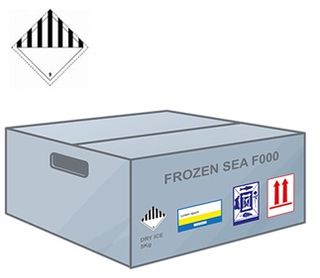
- Packages with dry ice must bear the “DRY ICE” label, including the amount of dry ice.
Dry Ice Oxygenation Table
The dry ice oxygenation table is available for your review in the following document.
Additional Marking Requirements:
- The shipper’s and consignee’s name, address, and telephone number must be clearly marked.
- If dry ice is used, indicate the amount of dry ice in kilograms.
- For seafood shipments, the label should state “Frozen Seafood” or “Live Seafood”, as applicable, and “Live Animal Regulations” must be followed if transporting live seafood.
Coolants and Isolating Materials
Coolants:
- Wet Ice: Packaged in polyethylene bags (1 kg each). Ice must be secured with an elastic band or moisture-resistant tape.
- Ice: Regulated as hazardous material, requiring compliance with IATA’s regulations. Containers must have ventilation openings.
- Gel Packs: These are frozen before use and can maintain lower temperatures than wet ice but not as low as dry ice.
- Deep Cooled Liquefied Gas (DCLG): Must comply with IATA’s Hazardous Materials Regulations.
Isolating Materials:
- Thermal Blankets and Liners: Used to protect perishables from extreme temperatures during transportation.
- Reflective Covers: Help to isolate products from the sun and maintain the appropriate temperature.
Perishable cargo example: Fresh, Chilled and Frozen Meat Acceptance

Meat is accepted in waterproof, leak-proof containers, or in containers made waterproof through the use of polyethylene sheets. All shipments must adhere to the sanitary regulations of the countries of export and import.
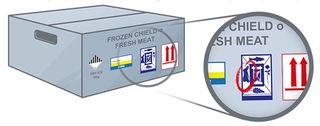
Example of proper packaging and labeling of a meat shipment cooled with dry ice.
Note: The outside of the box must be labeled with the type of product contained, i.e. “Frozen Meat”, “Chilled Meat”, or “Fresh Meat”.
FAQs
To request a shipment, go to our E-minuta page and fill in the main details of your cargo.