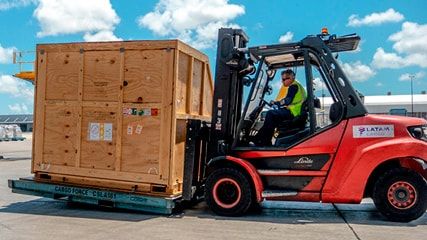
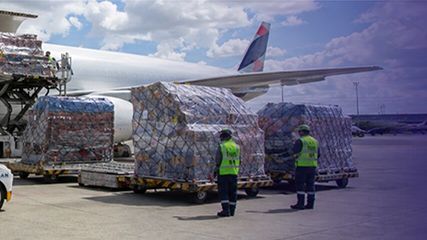
Live Animals
The Premier Solution for Live Animal Transportation
Our Live Animals care is tailored to ensure the safe, comfortable, and seamless transportation of live animals, adhering to the highest global standards. Each animal is treated with the utmost care and respect, ensuring their journey is as stress-free as possible.
Why Choose Live Animals?
- Strict IATA Compliance: Fully aligned with Live Animal Regulations (LAR) to guarantee safety and legal assurance.
- Specialized Handling: Managed by expertly trained personnel for delicate care throughout the journey.
- Tailored Coordination: Proactive support for animal companions, especially for horse and livestock shipments.
- Optimal Conditions: Segregated storage areas with controlled temperature and oxygenation to ensure animal well-being.
- Priority Treatment: Highest boarding priority for efficient transit and minimized delays.
- Speed and Efficiency: Reduced reception and delivery times for a seamless experience.
- Real-Time Communication: Immediate updates and resolutions in case of any exceptions.
The transportation service for animals in the cargo hold will be subject to prior evaluation and approval, considering the pet’s weight, aircraft type, schedule, pre-booked cargo, available space in the cargo hold, and flight duration.
In some situations, even after confirmation, pet transportation may be altered or rejected due to flight schedule adjustments, aircraft changes, and other adverse conditions that could compromise the animal’s health.
Every analysis, measure, and decision aims to protect the animal’s health.
Product information
Additional services for horses and livestock
- Confirmed ticket for companions on passenger flights.
- Positioning of Stables: Location and availability of stables throughout our network.
- Stable Rental: Rental coordination and positioning by specialized personnel.
Note: These services are subject to additional costs and conditions.
Transporting pets (dogs and cats)
Pet Requirements
- Must meet the required documents of the origin, transit, and destination countries.
- Dogs and cats must be at least 16 weeks old for transport.
- Must not be a pregnant female or have given birth in the last 7 days.
- Must not have unweaned offspring.
- Brachycephalic breeds or their crossbreeds are not accepted. You can see the list here.
Documentary Requirements
- Health certificate issued by an official officer from the country of origin.
- Rabies vaccination certificate according to the regulations of the involved countries.
- Veterinary certificate stating that the dog/cat is not brachycephalic.
- Specific certificates required by each transit country where the pet will pass through.
- Shipper’s certificate for live animals, presented in the IATA form in English.
- For domestic transportation within the same country, local regulations must be considered.
- Additional information can be found in the IATA Live Animal Regulation and the TACT (The Air Cargo Tariff) Rules, sections 7 and 8.
Container Requirements and Specifications
We invite you to read the following Kennel information guide prepared especially for you, and to see the next video with instructions.
Some of the key points mentioned in the document:
- The kennel or container must be appropriately sized for your pet.
- The kennel or container’s construction materials must be sturdy, either plastic or solid wood, depending on the breed.
- Must have ventilation on all four sides, with holes that do NOT allow the insertion of claws or snout.
- Joints must be secured with metal bolts or screws, and the door locking system must have latches on the top and bottom edges.
- Must include a water container and food dish attached to the door, accessible from the outside.
- Must contain clean and sufficient absorbent material for the journey.
- For potentially dangerous dog breeds over 9 months old, check the list here. It is necessary to use a solid wood kennel reinforced with a metal frame. The use of plastic kennels is prohibited for these breeds.
A solid wood kennel reinforced with a metal frame (CR 82 model) is required. Plastic kennels are prohibited for these breeds.
Other Transportation Recommendations
- Do not sedate or tranquilize your pet without prior authorization from a certified veterinarian.
- Confirm your reservation in advance and check delivery and pickup times.
- Write your pet’s name in a visible part of the kennel.
- Include a note with a 24-hour emergency contact.
- If your pet has any medical condition (paraplegia, deafness, etc.), it must be indicated in the veterinary certificate.
- Water and food containers must be attached inside the door and accessible from the outside.
| Pet's age | Trip Duration (Considering acceptance times at origin and delivery at destination) | Type of flight | Water container? | Does the water container have to be full? | Food container? | Does the food container have to be full? |
|---|---|---|---|---|---|---|
| Younger than 1 year | Always | All | Mandatory | Yes | Mandatory | No* |
| Older than 1 year | Up to 7 hours | Direct route | Mandatory | No | Mandatory | No |
| Connection | Mandatory | Yes | Mandatory | No* | ||
| Over 7 hours | All | Mandatory | No | Mandatory | No* |
Kennel or Transport Container Acclimatization
Acclimatization is a gradual process where you get your pet used to being inside the kennel comfortably so that when the travel time comes, they are calm. This should be done ALWAYS when your pet has a LATAM flight.
- TIME: The process must begin at least 3 weeks before the trip.
- TRAVEL CRATE: You must select a suitable crate for their size and safety.
- DEVOTION: Devotion and care are needed to succeed.
To help you in this process download here, advice, tips and steps to achieve acclimatization successful.
Additional information for pets
All reservations for pets travelling internationally must be made through a certified freight forwarder to prioritize their safety and ensure compliance with regulations.
Since December 2018, we’ve been proud members of IPATA, an organization dedicated to the safe and humane transportation of pets and other animals. For freight forwarder recommendations, visit the IPATA website.
United States specific regulations
The CDC (Centers for Disease Control and Prevention) restricts the entry into the United States of dogs from countries with a high risk of rabies transmission, such as Bolivia, Brazil, Colombia, the Dominican Republic, Ecuador, Peru, and Venezuela, or those that have been in those countries within the last six months prior to entering the country. In these cases, the dog must meet the indicators requirements:
- Must be healthy
- Be at least 6 months old.
- Have an import form issued on the CDC website.
- Have a microchip. The microchip number must be included on all required forms and documents.
- You must be vaccinated against rabies and have a document proving this.
Depending on the country where the dog was vaccinated, there are entry restrictions and additional requirements may apply:
Dogs vaccinated in the United States:
- Rabies vaccination form issued in the US.
- Export health certificate endorsed by a USDA-affiliated veterinarian (see list of approved clinics and veterinarians).
- Point of entry: You may enter the United States from any airport, as long as it is the same one declared on the CDC import form.
Dogs vaccinated outside the United States:
- Confirmation of care reservation at a CDC-registered Animal Care Facility (ACF).
- Rabies vaccination form and foreign microchip (endorsed by an official government veterinarian).
- Valid rabies serology report from a CDC-approved laboratory (in English or with certified translation).
- Point of entry: Animals may only enter the United States at airports that have an Animal Care Facility (ACF).
Important:
- The LATAM destinations with these facilities are New York (JFK), Atlanta (ATL), Los Angeles (LAX) and Miami (MIA).
- Orlando (MCO) and Boston (BOS) airports are not authorized to accept vaccinated dogs from countries outside the United States that are at high risk for rabies for any Pet in Cabin or Pet in Cargo
- These conditions are for reference only and may change without notice. Therefore, we ask you to always check the CDC website for details. Compliance with these conditions is a requirement for shipment.
Dogs from countries not on the high-risk list for rabies
Dogs from countries not on the high-risk list for rabies, such as Argentina, Chile, Paraguay, and Uruguay, must meet the following requirements:
- Must be healthy.
- Be at least 6 months old.
- Have an import form issued on the CDC website.
- Have a microchip. The microchip number must be included on all required forms and documents.
Please note: If your itinerary includes a connection in a country with a high risk of rabies, such as Brazil, Colombia, Ecuador, and Peru, your dog must meet the origin requirements for those countries even if you do not leave the airport departure lounge.
Travel to or from New York or Boston (Temperature restrictions apply)
If you’re traveling to or from New York or Boston between December 15 and April 25, you won’t be able to bring your pet in the cargo hold due to the low temperatures during those months. However, you can bring their company in the cabin, provided they meet the transportation requirements.
Transporting poultry less than 72 hours old
Poultry (chickens, turkeys, geese, or ducks) younger than 72 hours old are extremely sensitive to temperature and humidity. For this reason, the container in which they are transported must meet the specifications established for Container 19 of the IATA Live Animal Regulation (LAR).
During periods when the temperature exceeds 24°C (75°F), the number of birds inside the box must be reduced by 10%.
Container Characteristics
- Permitted materials: Corrugated cardboard, rigid plastic, non-toxic plastic, fiberglass, and synthetic materials.
- Internal divisions: Must have 2 or 4 compartments, with a capacity for 50 to 100 chicks. In the case of turkeys, geese, or ducks, the quantity must be reduced by 20%.
- Temperature conditions: If the temperature exceeds 24°C, the number of birds inside the box must be reduced by 10%.
- Minimum internal height: 14 cm (5 ½ in), with ventilation openings up to 1 cm (⅖ in).
- Required labels: The use of the “Live Animals” label is not necessary, but the “This Way Up” label MUST be used.
- Food and water: No food or water supply is required during transport.
- Temperature ranges: The required temperature values must be provided for the proper transport of the chicks.
Contact
For general inquiries about packaging, destinations, and more information on pet transportation, contact us at: pawssupport@latam.com.
For urgent matters or contingencies related to your pet, email us at: petsemergency@latam.com.
To make a domestic reservation in Brazil, click here.
To make a domestic reservation in Chile, Colombia or Peru, click here.
FAQs
You may request a quote online in our quotes section or, if you prefer, you may communicate directly with our local sales offices.